What is the role of ethics in business?
Ethics
in general is concerned with human behavior that is acceptable or "right" and that is not acceptable or
"wrong" based on conventional morality. General ethical
norms encompass truthfulness, honesty, integrity, respect for others,
fairness, and justice. Ethical norms are essential for maintaining
stability and harmony in social life, where people interact with one
another. They relate to all aspects of life, including business
Marketing,
finance
and
human resource.
Financial, marketing
and human resource
ethics is, therefore, a subset of general ethics.

Market research has experienced a resurgence with the widespread use of the Internet and the popularity of social networking. It is easier than ever before for companies to connect directly with customers and collect individual information that goes into a computer database to be matched with other pieces of data collected during unrelated transactions.The way a company conducts its market research these days can have serious ethical repercussions, affecting the lives of consumers in ways that have yet to be fully understood. Further, companies can be faced with a public backlash if their market research practices are perceived as unethical.
Another type of anti-competitive policy is planned obsolescence. It is a method of designing a particular product having a limited useful life. It will become non-functional or out of fashion after a certain period and thereby lets the consumer to purchase another product again.

Current ethical and unethical issues in:-
1. Human resource Management:-
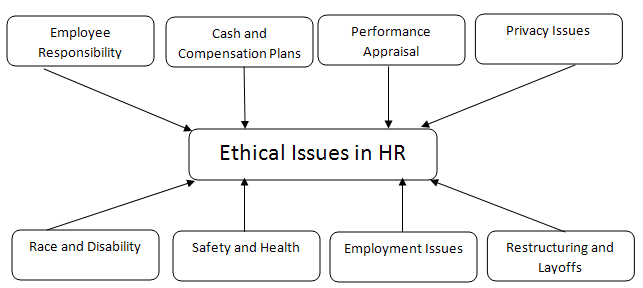
Paying attention to business ethics is an important part of any business owner or manager's job. The human resources function deals with a variety of ethical challenges; being the department that deals directly with people employed by a company, HR includes numerous ethical pitfalls that can damage a company's reputation or financial sustainability if not handled properly. Understanding the importance of ethics in human resources is crucial for any business owner, whether in a local startup or a multinational powerhouse.
Cash and Compensation Plans
There are ethical issues pertaining to the salaries, executive perquisites and the annual incentive plans etc. The HR manager is often under pressure to raise the band of base salaries. There is increased pressure upon the HR function to pay out more incentives to the top management and the justification for the same is put as the need to retain the latter. Further ethical issues crop in HR when long term compensation and incentive plans are designed in consultation with the CEO or an external consultant. While deciding upon the payout there is pressure on favoring the interests of the top management in comparison to that of other employees and stakeholders.Race, gender and Disability
In many organisations till recently the employees were differentiated on the basis of their race, gender, origin and their disability. Not anymore ever since the evolution of laws and a regulatory framework that has standardized employee behaviors towards each other. In good organisations the only differentiating factor is performance! In addition the power of filing litigation has made put organisations on the back foot. Managers are trained for aligning behavior and avoiding discriminatory practices.Employment Issues
Human resource practitioners face bigger dilemmas in employee hiring. One dilemma stems from the pressure of hiring someone who has been recommended by a friend, someone from your family or a top executive.Yet another dilemma arises when you have already hired someone and he/she is later found to have presented fake documents. Two cases may arise and both are critical. In the first case the person has been trained and the position is critical. In the second case the person has been highly appreciated for his work during his short stint or he/she has a unique blend of skills with the right kind of attitude. Both the situations are sufficiently dilemma-tic to leave even a seasoned HR campaigner in a fix.- Privacy IssuesAny person working with any organisation is an individual and has a personal side to his existence which he demands should be respected and not intruded. The employee wants the organisation to protect his/her personal life. This personal life may encompass things like his religious, political and social beliefs etc. However certain situations may arise that mandate snooping behaviours on the part of the employer. For example, mail scanning is one of the activities used to track the activities of an employee who is believed to be engaged in activities that are not in the larger benefit of the organisation.Similarly there are ethical issues in HR that pertain to health and safety, restructuring and layoffs and employee responsibilities. There is still a debate going on whether such activities are ethically permitted or not. Layoffs, for example, are no more considered as unethical as they were thought of in the past.
2. Sales and marketing:-
Markets present a clash of interest between various players. There is competition for resources, customers and price etc, which breeds ground for activities that may not get ethical sanctions. A certain code of conduct, policies and practices called ethics are required to manage markets and marketing.
Ethical issues in marketing arise from the conflicts and lack of agreement on particular issues. Parties involved in marketing transactions have a set of expectations about how the business relationships will take shape and how various transactions need to be conducted. Each marketing concept has its own ethical issues, which we will discuss in this chapter.

-
Emerging Ethical Problems in Market Research:-
Emerging Ethical Problems in Market Research:-
Market research has experienced a resurgence with the widespread use of the Internet and the popularity of social networking. It is easier than ever before for companies to connect directly with customers and collect individual information that goes into a computer database to be matched with other pieces of data collected during unrelated transactions.The way a company conducts its market research these days can have serious ethical repercussions, affecting the lives of consumers in ways that have yet to be fully understood. Further, companies can be faced with a public backlash if their market research practices are perceived as unethical.
-
Grouping the Market Audience:-
Unethical practices in marketing can result in grouping the audience into various segments. Selective marketing may be used to discourage the demand arising from these so-called undesirable market segments or to disenfranchise them totally.Examples of unethical market exclusion may include the industry attitudes towards the gay, ethnic minority, and plus-size groups.
-
Ethics in Advertising and Promotion
In the early days of existence of corporations, especially during 1940's and 1950's, tobacco was advertised as a substance that promotes health. Of late, an advertiser who does not meet the ethical standards is considered an offender against morality by the law.Sexuality is a major point of discussion when ethical issues in advertising content are considered. Violence is also an important ethical issue in advertising, especially where children should not be affected by the content.Some select types of advertising may strongly offend some groups of people even when they are of strong interest to others. Female hygiene products as well as hemorrhoid and constipation medication are good examples. The advertisements of condoms are important in the interest of AIDS-prevention, but are sometimes seen by some as a method of promoting promiscuity that is undesirable and strongly condemned in various societies.A negative advertising policy lets the advertiser highlight various disadvantages of the competitors’ products rather than showing the inherent advantages of their own products or services. Such policies are rampant in political advertising.
Grouping the Market Audience:-
Ethics in Advertising and Promotion
Delivery Channels
Deceptive Marketing Policies and Ethics
Anti-Competitive Practices
Another type of anti-competitive policy is planned obsolescence. It is a method of designing a particular product having a limited useful life. It will become non-functional or out of fashion after a certain period and thereby lets the consumer to purchase another product again.
3. Finance:-
Organizations that provide financial services cannot afford to have its employees leave their morals on the front door when they step inside. Finance usually depends on a very high level of ethics.
Markets break down without trust. If financial markets are full of rogue traders, individuals will start to disengage from it, thereby reducing the capacity to find investments and hence reducing the economic growth. A market with strong ethics is more inclusive which helps it to be more liquid and offer cheaper financial options.
Financial market participants often have economic freedom, and often with good reason, but the successful financial exchanges in the world are more famous for trust than the degree of their freedom.
If trust is important and if it cannot be achieved by laws alone, how important is it to have agreements and moral codes that are beyond the law, especially when the law is often the way to codify the ethical behaviors?
- Most large companies have a code of ethics—a set of general guidelines to encourage employees to behave ethically and responsibly
- In addition to the company specific codes of ethics, companies and professionals are also bound by ethical codes of conducts of numerous professional organizations and institutions.
- Experts also agree that ethical behavior is governed more by the individual rather than the environment.
- Once a code of ethics consistent with the actions of the company is established, it needs to be communicated across the company.
